Home Flip: Crazy Jump Master
- 4.4
- Rating
- 50.00M
- Installs
- Free
- Price

 Analysis by App-foxy
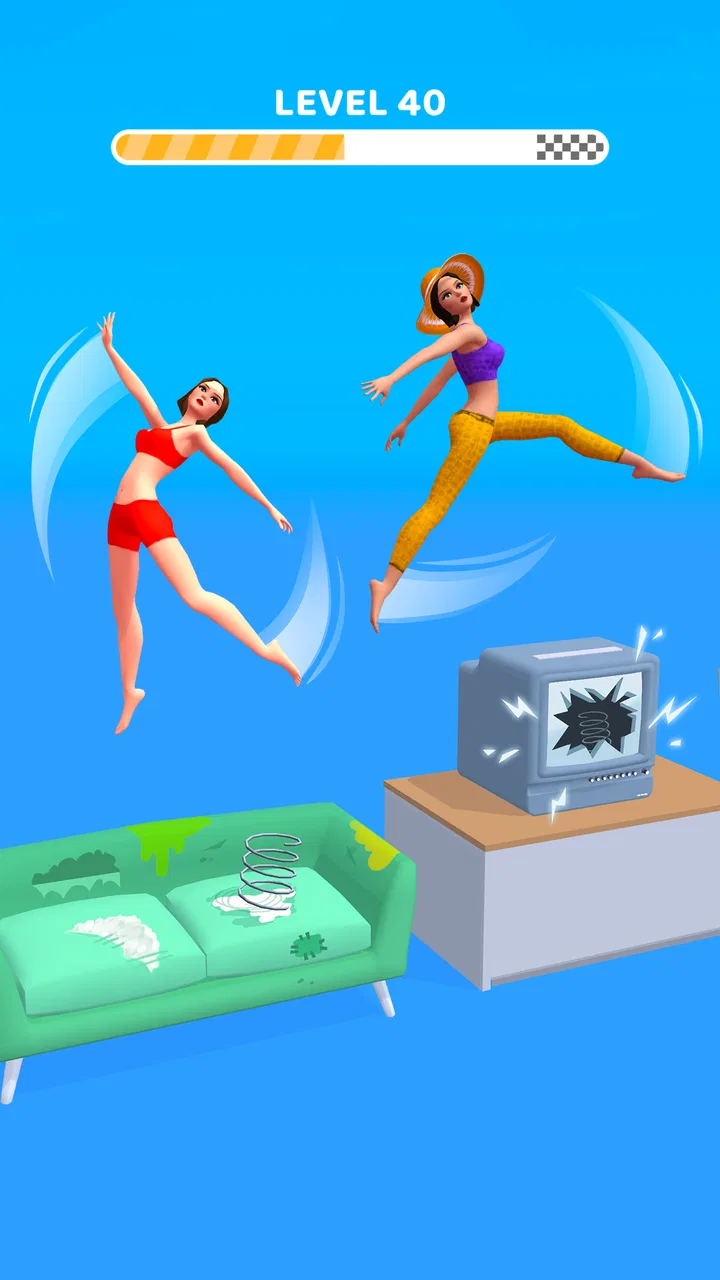
Home Flip: Crazy Jump Master is the kind of action game I open when I want something quick, silly, and easy to understand without committing to a long session. The idea is simple: guide a ragdoll through a room, flip over obstacles, and try to land cleanly on a bed. That sounds straightforward, but the timing becomes surprisingly demanding once the furniture starts interrupting your path.
I found the appeal in the short feedback loop. I make a move, watch the character rotate through the air, and immediately see whether the landing worked. There is no complicated story to learn before playing, and the basic objective is clear from the first attempt. For a first-time player, that makes it approachable, especially if you are looking for a casual action game rather than a large adventure with menus, missions, and lengthy tutorials.
It is free to download, and CASUAL AZUR GAMES is the developer behind it. The game has reached over 50 million installs and holds a 4.4 average from around 27 thousand ratings, which matches my impression that its quick, physical comedy has broad appeal. It is marked for Teen players, so I would still check whether its style suits a younger player before handing over the phone.
You May Also Like

 Blood Strike: 2.5 Anniversary
Blood Strike’s Loadouts Turn Every Drop Into a Tactical Gamble
A close look at Blood Strike’s custom loadouts: how fast access to signature weapons reshapes its battle royale rhythm, rewards preparation, and narrows the gap between fights.

 Pandora - Music & Podcasts
Pandora’s Music Is Easy to Start, but Harder to Recover
Pandora’s strength is its low-effort path from a seed to a station. Its weak spot is how much confidence it asks you to place in connection, setup, and quiet recovery.

 8 Ball Pool
 Is Built on Rivalries, Rematches, and Routine
A close look at the rivalries, rematches, shared routines, and unanswered safety questions that turn a quick pool match into a persistent mobile community.

 Samsung Music
’s Quiet Strength Is Playing What You Already Own
Its reach comes less from spectacle than from dependable access to a personal library. That simplicity is both the app’s strongest retention engine and its ceiling.

 AccuWeather: Weather Radar
AccuWeather Review: A Quick, Clear Forecast for Everyday Decisions
For everyday plans, the best forecast is the one you can understand quickly. AccuWeather makes rain timing, radar, and local conditions easy to act on, with a few trade-offs.

 Hill Climb Racing
Why Hill Climb Racing Still Turns Crashes Into One More Run
A tiny car, a bumpy hill and one more upgrade: Hill Climb Racing keeps resurfacing because its simple chaos makes every near-miss feel personal.
More From Our News Desk



Getting from the first launch to a clean landing
I’ll focus on how I read each attempt rather than treating a clean landing as pure luck: the useful question is whether the launch, rotation, or final alignment needs attention. That gives a first-time player a simple way to turn an awkward bounce into a specific next move. Once that rhythm feels manageable, the next section can look at what tends to make an otherwise promising jump go wrong.
What the first session feels like
The opening experience is deliberately light. You do not need to memorize a control scheme or understand a complicated economy before attempting a jump. The central task is to flip the ragdoll body through the room and finish with a successful landing. That clarity is one of the game’s strongest qualities: I always know what I am trying to do, even when I do not yet know the best timing.
The challenge comes from controlling momentum rather than simply pressing a button at random. A jump can look promising at the start and still fail because the character is rotating too far, approaching the bed at the wrong angle, or meeting an obstacle in the middle of the movement. I quickly stopped treating each attempt as a race and started watching the entire arc. That small change made the game feel less frustrating and more like a timing exercise.
For everyday use, it fits naturally into spare moments. I can play a few attempts while waiting for an appointment, take a short break from work, or pass time during a commute. The individual challenges do not require me to remember a plot or rebuild a strategy from scratch. The trade-off is that the same focused format may feel repetitive if you prefer games with exploration, character development, or a large variety of long-term objectives.
What to do after installing it
My advice for a new player is to begin with the default control behavior and learn the movement before worrying about perfect results. The first useful goal is not a stylish landing; it is simply understanding how an input changes the ragdoll’s rotation. Make one deliberate attempt, observe whether the body turns too early or too late, and adjust only one part of the timing on the next try.
This sounds obvious, but it matters because the character’s loose, physical movement can tempt you into making several corrections at once. When I changed direction repeatedly during a jump, I often lost track of which action caused the mistake. A calmer approach works better: start the flip, watch the body, and use the next attempt to correct the most obvious problem.
The game is available for devices running Android 7.0 or later. On a compatible phone, the setup is uncomplicated from the player’s point of view: install it, open it, and begin learning through attempts. The current version is 2.6.01, so I would make sure the app is updated through the normal store process before judging its controls, particularly if an older installation behaves differently.
Because it is free, it is easy to try without making an immediate purchase. However, the game includes in-app purchases priced from $1.99 to $9.99 per item. I would treat those as optional rather than part of the basic learning path. A new player can first decide whether the flipping itself is enjoyable, then consider spending only if the game earns a regular place in their routine.
Your first meaningful success
The first satisfying milestone is a landing that feels intentional rather than lucky. I recommend aiming for a simple, controlled flip instead of trying to perform the most dramatic movement immediately. Watch the character’s body position as it approaches the bed and try to finish with the torso aligned for contact. Even when the result is not perfect, this teaches more than repeatedly tapping without observing the outcome.
One useful habit is to separate the jump into three moments: launch, rotation, and landing. During launch, focus on creating a predictable path. During rotation, avoid panicked corrections unless the body is clearly heading away from the target. During landing, prioritize alignment over extra movement. This three-part mental checklist helped me turn failures into information, and it is more useful than simply trying to react faster.
The bed is not just a finish line; it is also a visual reference. I use its position to judge whether the character is drifting too far forward or backward. If I repeatedly land short, I adjust the beginning of the movement rather than trying to fix everything at the last instant. If I overshoot, I reduce the early rotation. This is a small but important insight: late corrections look dramatic, but early timing usually determines the result.
When a clean backflip finally works, the reward is immediate and easy to understand. That is why the game can feel satisfying even without the depth of a traditional platformer. The pleasure comes from improving a physical action that looked chaotic a moment earlier. I would not describe it as a deep simulation, but it does create a pleasant sense of control once the timing begins to click.
Why failed attempts can feel confusing
The most common confusion for a first-time player is assuming that every failure means the input was completely wrong. In practice, a near miss can come from a small difference in rotation, approach, or release timing. The ragdoll presentation makes mistakes entertaining, but it can also hide the exact cause. I learned to replay the movement in my head rather than blaming the entire attempt.
Another source of friction is the temptation to chase a perfect backflip before mastering a basic landing. The store summary emphasizes that goal, but I found it more productive to build consistency first. Once I could predict where the body would go, attempting a more precise flip became less random. New players should not interpret early awkward landings as a sign that they are playing incorrectly; the game’s appeal depends on gradually reading the motion.
Obstacles also change how I approach each attempt. A route that looks open at launch may become difficult because the character’s body occupies more space while rotating. I try to think of the ragdoll as having a wide, moving shape rather than as a single point. That perspective helps explain why a jump that appears to clear furniture can still collide with it.
There is also a practical difference between playing for completion and playing for style. If I only want to reach the bed, I choose the safest movement I can. If I want a more impressive flip, I accept more failed attempts. Knowing which goal I have before starting prevents unnecessary frustration. This is especially helpful during a short break, when I may want a quick win rather than a demanding experiment.
A realistic short-session routine
Imagine that I have five minutes before leaving home. I open the game and make one attempt without changing anything. If the character rotates too slowly, I focus on a slightly earlier or stronger movement on the next try. If the character reaches the bed but lands badly, I preserve the successful path and change only the final alignment. After several attempts, I stop when I have either achieved a clean landing or learned a specific correction to try later.
This routine works because it gives each attempt a purpose. I am not mindlessly repeating the same jump; I am testing one adjustment at a time. It also keeps the game from taking over a short break. For me, that is where Home Flip works best: as a compact challenge that rewards attention without demanding a full evening.
Players who enjoy recording or sharing amusing physics moments may also appreciate the unpredictable failures, although I would not install it solely for that reason. The ragdoll behavior creates funny outcomes naturally, but the core experience remains about timing and landing. If you prefer polished competitive matches, ranked progression, or precise platforming with strict rules, another action title may suit you better.
How it compares with familiar alternatives
Compared with endless runners, this game feels more deliberate. An endless runner usually asks me to react continuously as the environment moves toward the character. Here, the important decision is concentrated around a jump and its landing. That makes Home Flip easier to pick up for a short session, but it may feel less energetic to someone who wants uninterrupted movement.
Compared with conventional platformers, it places more emphasis on the character’s physical rotation than on walking, jumping across a map, or collecting items. I do not approach it like a traditional precision platformer. The loose ragdoll style makes mistakes funnier and movement less predictable, while a standard platformer generally offers clearer control and more structured level mastery.
It also differs from physics puzzle games because the objective is not mainly to arrange objects or solve a static mechanism. The challenge is personal timing: I am controlling the body through an obstacle-filled space and trying to finish on the bed. That distinction matters when choosing it. Players seeking quick physical comedy and repeated attempts will probably understand its appeal immediately; players seeking elaborate puzzles may find the interaction too narrow.
The game’s simplicity is therefore both its advantage and its limitation. I can understand it quickly, but I should not expect the breadth of a full console-style action game. Its best comparison is not a large adventure or a competitive multiplayer title. It is a focused, pick-up-and-play challenge built around movement, mistakes, and the satisfaction of a successful flip.
Who should try it, and who should skip it?
I would recommend it to players who enjoy short action challenges, exaggerated physics, and games where improvement comes from repeating one movement with better timing. It is also a good choice for someone who wants a free game that can be understood immediately. The Teen content rating is worth considering for families, and the optional purchases are another reason to review spending settings before letting someone else play.
I would be less likely to recommend it to a player who needs a strong story, deep customization, lengthy exploration, or a clear competitive ladder. The game’s central idea is intentionally focused. If the first few attempts do not make the flipping itself enjoyable, additional play is unlikely to solve that mismatch. Likewise, anyone who dislikes ragdoll collisions or trial-and-error movement may find the same qualities irritating rather than funny.
There is a useful middle ground for casual players who normally avoid action games. Because the goal is visible and the sessions can remain short, it does not demand the reflex commitment of many fast arcade alternatives. Still, success requires patience. The controls may be easy to understand, but producing a reliable landing is not always immediate.
What to expect from continued play
With more time, I focus less on merely reaching the bed and more on making the route repeatable. I pay attention to the first movement, the body’s rotation, and the point where the obstacle becomes a threat. This creates a simple improvement cycle: identify the moment that went wrong, change one decision, and test it again. That method is more rewarding than hoping a random attempt will suddenly work.
I also recommend taking a break after a string of identical failures. Because each attempt is short, it is easy to repeat a mistake without noticing. Returning with a fresh eye often helps me see that I was starting the flip too early or trying to correct too late. The game benefits from short, focused practice more than from exhausted repetition.
Purchases should be approached carefully. The free entry point is enough to evaluate whether the core movement suits you, while the available items can add spending to an otherwise optional pastime. I would not buy anything during the first session. First learn the controls, decide whether the challenge remains enjoyable after the novelty fades, and only then consider whether an item genuinely improves your experience.
Overall, Home Flip: Crazy Jump Master succeeds because it makes one small action entertaining: sending a ragdoll through a room and trying to land properly. I like that the first meaningful goal is clear, the failures are usually amusing, and a few minutes can produce a real sense of improvement. At the same time, its narrow focus means it is not a replacement for a deeper action game.
My recommendation is simple: install it if you want a free, compact challenge and enjoy learning through physical trial and error. Start with controlled landings, use the bed as your visual guide, and change one timing decision at a time. If that process feels satisfying, the game has enough charm to become a reliable short-break companion. If you need story, exploration, or long-term variety, choose a broader alternative instead.
FAQs for Home Flip: Crazy Jump Master
01What is Home Flip: Crazy Jump Master about?
Home Flip: Crazy Jump Master is a fun and engaging mobile game where players perform acrobatic flips in various home settings. The objective is to land perfectly on designated spots to score points. With intuitive controls and dynamic levels, it offers a unique blend of strategy and skill, making it addictive for players of all ages.
02Is Home Flip: Crazy Jump Master free to play?
Yes, Home Flip: Crazy Jump Master is free to download and play. However, like many mobile games, it offers in-app purchases that can enhance the gaming experience, such as additional characters or special abilities. While these purchases are optional, they can provide an advantage or cosmetic upgrades for those who choose to invest.
03What are the main features of Home Flip: Crazy Jump Master?
The game boasts a variety of features including diverse levels with increasing difficulty, a range of characters to unlock, and engaging graphics. It also offers smooth physics-based gameplay, allowing players to execute complex flips and tricks. Regular updates introduce new challenges and content to keep the game fresh and exciting.
04Does Home Flip: Crazy Jump Master require an internet connection?
Home Flip: Crazy Jump Master can be played offline, making it perfect for on-the-go gaming without the need for data or Wi-Fi. However, certain features, such as leaderboard rankings or purchasing in-game items, may require an internet connection to function properly.
05How does Home Flip: Crazy Jump Master handle player data and privacy?
The game adheres to standard privacy policies, ensuring that player data is handled securely. Users should review the app's privacy settings and terms of service to understand what information is collected and how it is used. Generally, data collected is for improving gameplay experience and targeting advertisements.
Pros
- Addictive gameplay with simple controls
- Vibrant and colorful graphics
- Variety of levels for extended fun
- Challenging physics-based mechanics
- Regular updates with new content
Cons
- In-app purchases can be expensive
- Occasional ads interrupt gameplay
- Requires internet for some features
- Limited character customization
- Can drain battery quickly on older devices

Home Flip: Crazy Jump Master
Gallery